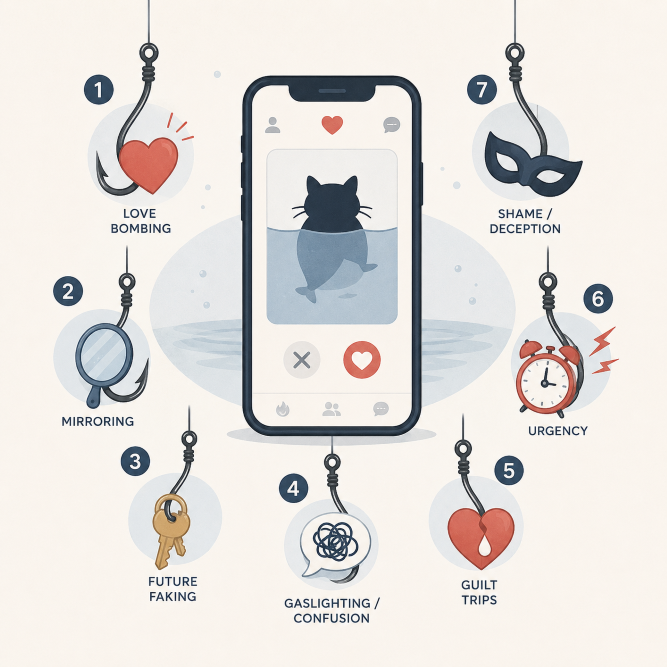


Catfishing may be a business, but the emotional damage can feel deeply personal. That is especially true if you are a survivor of narcissism. When we talk about catfishing, people often focus on fake profile pictures, dramatic stories, suspicious excuses, and requests for money. But what often gets overlooked is how many catfishers use the same emotional tactics that show up in narcissistic relationships.
Here are seven ways catfishers use narcissistic tactics, how to recognize them, and how to respond.

1. Love Bombing & Narcissism
Love bombing is intense affection, attention, or praise that arrives too quickly. It can feel flattering at first, especially if you have been lonely, grieving, healing, or simply hoping to meet someone kind.
A catfisher may say things like:
“You are unlike anyone I’ve ever met.”
“I feel like I’ve known you forever.”
Now, could a real person feel excited early? Sure. We are not against butterflies here. Butterflies are lovely. The problem is not sweet feelings of affection. The problem is intensity without reality. If someone barely knows you but is already building an emotional mansion with a wraparound porch and matching rocking chairs, pause.
How to recognize the narcissism
Ask yourself:
- Do they seem attached to me, or to the fantasy of me?
- Are they rushing emotional intimacy before basic trust exists?
- Do their words feel big, but their evidence feel small?
Love bombing creates a false sense of closeness.
How to respond
Slow the pace.
You might say, “I’m enjoying getting to know you, but I move slowly. I don’t build trust through words alone.”
A genuine person may feel a little disappointed, but they will respect the pace. A manipulative person will often pressure, pout, disappear, or accuse you of being unreasonable. That response tells you a lot.

2. The Mirror Game
Mirroring is when someone reflects your interests, values, wounds, dreams, or personality back to you so quickly and precisely that it feels like fate.
You love the beach? Suddenly they love the beach.
You have been hurt before? They’ve been hurt in the exact way that makes them sound safe.
You value honesty? Wouldn’t you know it, honesty is their best quality.
Mirroring makes catfishing feel intimate. They are collecting information and feeding it back in a way that makes you feel seen. For survivors of narcissistic abuse, this can be especially disorienting because narcissists often mirror at the beginning too. They become the dream. The safe place. The person who finally understands. Until the mask slips.
How to recognize the narcissism
Notice whether they reveal themselves gradually or simply agree with everything you say.
A real connection includes differences. A real person has texture. They have preferences, opinions, quirks, contradictions, and a life that does not perfectly orbit yours.
If someone seems like a custom-made human made just for you, stay curious.
How to respond
Hold some information back early on. You do not have to hand someone your whole emotional blueprint in the first week.
Then ask specific questions and look for consistency over time.
For example, “You said family is important to you. What does a normal weekend with them look like?”
Real people usually have real details. Catfishers often stay vague, overly dramatic, or strangely polished.

3. Future Faking
Future faking is when someone talks about a beautiful future they have no real intention, ability, or honesty to build.
This is powerful because the relationship may not have much present-day evidence. You may not have met. You may not have video chatted. You may not even know whether their name is real. But the future feels emotionally rich.
How to recognize the narcissism
Pay attention to whether the future talk is supported by present-day honesty.
Future faking is not the same as dreaming together. Healthy dreaming grows out of trust. Manipulative future faking tries to replace trust.
- Do they make plans but avoid verification?
- Do they talk about visiting but always have a crisis?
- Do they want emotional loyalty before they have shown real-life consistency?
How to respond
Bring the conversation back to the present.
You might say, “I’m not comfortable talking about a future until we have verified who we both are and spent real time getting to know each other.”
A safe person will understand. A manipulator may act hurt because you are not stepping into the fantasy fast enough.
That is useful information.

4. Gaslighting & Narcissism
Gaslighting is a form of emotional manipulation that makes someone question their perception, memory, or reality. The National Domestic Violence Hotline describes gaslighting as a tactic where someone’s emotions, words, and experiences are twisted and used against them, causing them to question their reality. (The Hotline)
Catfishers may gaslight when their story starts to crack. You notice an inconsistency. Instead of clarifying, they make you feel like the problem. They may say:
“You misunderstood me.”
“You’re too suspicious.”
“I can’t believe you would question me.”
Suddenly, you are not discussing their inconsistent story. You are defending your right to notice it. That is exactly what they want.
How to recognize the narcissism
Look for the spotlight shift.
- Did you ask about their behavior, only to end up defending your personality?
- Did you raise a concern, only to be accused of being damaged, paranoid, bitter, or unfair?
- Did the conversation leave you more confused than before?
Gaslighting often feels like mental fog. You may enter the conversation with a clear question and leave apologizing for having one.
Do not over-explain your concern.
You can keep it simple:
“I’m not asking because I want to argue. I’m asking because the details do not match.”
Or:
“I’m allowed to ask reasonable questions. If that feels offensive to you, this is not a good fit for me.”
You do not have to win the debate. You only have to notice the pattern.

5. All That Guilt
Guilt is one of the oldest tools in the manipulation toolbox. It is not fancy, but unfortunately, it works.
A catfisher may use guilt when you slow down, ask for proof, refuse to send money, decline to share photos, or say you are uncomfortable.
They may say:
“I thought you trusted me.”
“I guess I care more than you do.”
“After everything I told you, you still doubt me?”
For survivors of narcissism, this hits hard. Many survivors were trained to feel responsible for another person’s emotions, moods, disappointment, loneliness, or rage. So when a catfisher acts wounded, your nervous system wants to fix it.
How to recognize the narcissism
Ask yourself:
- Are they respecting my boundary, or making me comfort them for having one?
- Do I feel free to say no?
- Do I feel responsible for their emotional stability?
- Am I being asked to prove love, loyalty, or trust through compliance?
Guilt often turns a boundary into a test.
That is not connection. That is pressure.
How to respond
Use short, firm language.
“I’m not comfortable with that.”
“I don’t send money to people I haven’t met.”
“I don’t share private photos.”
You do not need a 14-slide PowerPoint presentation explaining why your boundary is valid. It is valid because it is yours.

6. Urgent Urgency
Urgency is a catfisher’s best friend.
They may have an emergency, a crisis, a travel problem, a banking issue, a sick relative, a frozen account, a business opportunity, a cryptocurrency tip, or a sudden emotional collapse that only you can fix. How convenient.
The Federal Trade Commission warns that if an online love interest asks for money, you should walk away, no matter how compelling the story; the FTC also advises contacting your bank or payment company immediately if you paid a scammer, reporting it to the FTC, and notifying the app or social media site where you met them. (Consumer Advice)
How to recognize the narcissism
Watch for pressure around time.
- Do they need a decision right now?
- Do they discourage you from talking to a friend?
- Do they make you feel cruel for pausing?
- Do they create a crisis right after you question them?
- Do they ask for money, gift cards, crypto, banking help, passwords, documents, or private photos?
Urgency plus secrecy is a flashing red sign. Not a cute little yellow flag. A giant red sign with blinking lights and maybe a tiny marching band.
How to respond
Slow everything down.
Say:
“I don’t make financial or personal decisions under pressure.”
“I’m going to take time to think.”
“I’m going to talk this through with someone I trust.”
A real person in a real emergency may be disappointed, but they will not require you to abandon your judgment.

7. And All That Shame
Shame is what makes people hide. And hiding helps scammers.
A catfisher may shame you directly by calling you suspicious, damaged, heartless, or foolish. But sometimes the shame comes from inside you after the deception becomes clear.
You may think:
“How did I not see this?”
“I should have known.”
“What is wrong with me?”
This is where catfishing can hit survivors of narcissism so hard. The scammer’s behavior activates an old story: that someone else’s deception is somehow proof of your defect.
It is not.
The FBI advises people who have been victimized by romance scams to stop contact with the scammer immediately and report romance scams through the FBI’s Internet Crime Complaint Center, known as IC3. (Federal Bureau of Investigation)
Reporting is not embarrassing. It is protective.
How to recognize the narcissism
If shame is telling you to stay silent, pause.
Ask:
- Would I blame a friend if this happened to them?
- Am I protecting myself, or protecting the scammer’s secrecy?
- Is shame keeping me from getting help?
- Am I turning their deception into my identity?
Shame says, “Hide this.”
Healing says, “Tell the truth somewhere safe.”
How to respond
Save evidence. Stop contact. Tell someone safe. Report the scam.

What to Do If You Think You Are Being Catfished or Scammed
If you suspect a catfisher or romance scam, PROTECT yourself first!
Here are practical steps:
- Stop sending money, gift cards, cryptocurrency, private photos, account access, or personal documents.
- Do not warn them at length or try to emotionally process with them. That often gives them more chances to manipulate you.
- Screenshot messages, profiles, payment requests, phone numbers, usernames, email addresses, and photos.
- Report the profile to the dating app or social media platform.
- If money was sent, contact your bank, credit card company, payment app, gift card company, or crypto platform immediately.
- Report the scam to the appropriate agencies.
- Tell a safe person. Shame thrives in isolation.
Where to Report Romance Scams and Catfishing
1. USA.gov Scam Reporting Tool
USA.gov has a scam reporting tool that helps you figure out where to report a scam based on what happened, where it happened, and what kind of scam it was. (USAGov)
2. Federal Trade Commission
The FTC’s fraud reporting site is the federal government’s website for reporting fraud, scams, and bad business practices. (ReportFraud.ftc.gov)
The FTC also has consumer guidance specifically about romance scams, including what to do if you paid a scammer and why you should report the profile to the app or social site where the scammer contacted you. (Consumer Advice)
3. FBI Internet Crime Complaint Center
The FBI’s IC3 accepts reports about cyber-enabled scams and fraud. The FBI says to report romance scams through IC3 and stop all contact with the scammer immediately if you have been victimized. (ic3.gov)
Reputable Sources to Learn More
If you want to understand the emotional manipulation side and the scam side, these sources are helpful:
- The National Domestic Violence Hotline explains gaslighting as emotional abuse that twists a person’s words, feelings, and experiences, causing them to question their reality. (The Hotline)
- WomensLaw.org describes gaslighting as a pattern where an abuser denies events as the victim knows they happened, causing the victim to doubt their perceptions. (WomensLaw.org)
- The FTC offers consumer education on romance scams and advice for reporting fraud. (Consumer Advice)
- The FBI explains romance scams and directs victims to report through IC3. (Federal Bureau of Investigation)
- USA.gov helps people identify where to report different kinds of scams. (USAGov)
Read “Why Gaslighting Is Hard to Explain“
Watch the latest podcast: “Catfishing After Being Gaslit.”